Covering smart doorbell cameras at night addresses several key security and privacy vulnerabilities. The infrared glow can actually attract potential intruders, while continuous nighttime recording may inadvertantly capture sensitive details through enhanced IR illumination. Technical issues like condensation and spider webs often trigger false alerts during darkness. Using privacy shutters or manual scheduling provides an effective solution that balances home security with privacy concerns. Understanding these nuances helps homeowners make smarter choices about their surveillance setup.
Why are growing numbers of homeowners choosing to cover their smart doorbell cameras during nighttime hours? As surveillance technology becomes increasingly sophisticated, experts have identified several compelling security and privacy concerns that make this nighttime precaution worth considering.
The enhanced capabilities of modern doorbell cameras, particularly their infrared night vision features, create unexpected vulnerabilities. While these devices can capture crystal-clear footage in complete darkness up to 9 feet away, they also emit a visible infrared glow that advertises their presence to potential intruders. This technological tell-tale sign can actually make homes more susceptible to targeted attacks, especially during off-peak hours when cyber criminals are most active. Additionally, it is crucial for homeowners to practice strong email security to guard against potential breaches that could exploit vulnerabilities in their smart devices. Furthermore, the importance of data protection cannot be overstated as it plays a critical role in mitigating risks associated with data breaches. Implementing cost-effective strategies is essential for small business owners to protect customer data and online operations.
Smart doorbells’ infrared glow acts like a beacon in the night, potentially alerting criminals to both camera presence and home security vulnerabilities.
Privacy implications extend beyond security concerns. The wide-angle lenses commonly found in smart doorbells frequently capture more than intended, potentially recording neighbors’ properties or public spaces without consent. This becomes particularly problematic at night when enhanced IR illumination can reveal sensitive details that wouldn’t be visible to the naked eye. Additionally, continuous video recording features, like Nest’s CVR, considerably increase exposure risks for both homeowners and passersby.

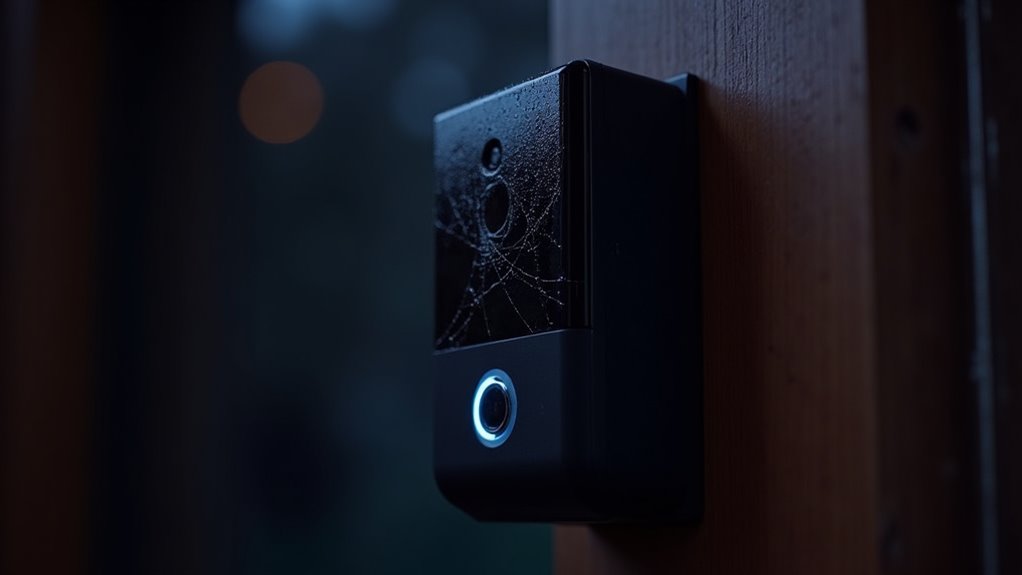
Technical limitations also plague nighttime operation. Condensation frequently builds up on lenses during humid nights, while spider webs and dust accumulation can trigger false motion alerts when illuminated by infrared beams. These issues not only compromise video quality but can lead to unnecessary notifications and potential missed security events. The black-and-white footage, though capable of capturing identifiable facial features, often suffers from overexposure when subjects are too close to the IR light source.
The legal landscape surrounding 24/7 surveillance remains complex and varies by jurisdiction. Many privacy laws haven’t kept pace with advancing technology, creating potential liability issues for homeowners who record continuously. This is particularly true for devices with audio recording capabilities, which face stricter regulations than video-only surveillance.
Fortunately, simple solutions exist. Using manual scheduling or smart switches to disable recording during nighttime hours can effectively address many of these concerns. Privacy shutters offer a physical barrier without requiring device removal or compromising the doorbell’s housing. For those requiring nighttime security, motion zones can be configured to reduce false alarms while maintaining essential coverage areas. Implementing strong password hygiene is also a crucial step in protecting smart devices from unauthorized access.
The decision to cover smart doorbell cameras at night ultimately reflects a growing awareness of the balance between security and privacy. While these devices offer valuable protection, their limitations and potential risks make nighttime coverage a prudent choice for many homeowners. By implementing appropriate precautions, users can maintain the benefits of smart surveillance while mitigating its drawbacks and vulnerabilities.
Frequently Asked Questions
Can Covering the Camera Affect Its Motion Detection Capabilities?
Covering a smart doorbell camera can greatly impact its motion detection capabilities.
When the camera lens or sensors are obstructed, the device’s ability to detect movement becomes compromised. The covering material interferes with both optical sensing and infrared technology, potentially leading to missed events or false triggers.

While the motion detection might still function partially, its reliability and accuracy will be reduced, especially if IR sensors are blocked by the covering material.
Will Covering the Doorbell Camera Void My Warranty?
Yes, covering a smart doorbell camera will typically void the manufacturer’s warranty.
Most warranty terms explicitly state that any physical modifications or coverings applied to the camera lens or sensors constitute unauthorized tampering.
Manufacturers consider this improper use since it impairs essential functions like motion detection and night vision.

Support forums consistently confirm that warranty claims are denied when evidence of camera covering is found, regardless of the user’s intentions.
What Materials Are Safe to Use for Covering Smart Doorbell Cameras?
Several safe materials can effectively protect smart doorbell cameras.
Weatherproof silicone covers, specifically designed for doorbell cameras, offer excellent protection while maintaining functionality. High-grade plastic shells with proper IP ratings provide durability against elements.
Clear polycarbonate covers guarantee unobstructed video quality. Some manufacturers also offer official protective covers that won’t void warranties.

Avoid DIY solutions like cardboard, cloth, or metal covers that could damage the device or interfere with its features.
How Does Temperature Fluctuation Affect Covered Doorbell Cameras During Nighttime?
Temperature fluctuations can greatly impact covered doorbell cameras at night. When warm daytime air meets cooler nighttime surfaces, condensation forms on or inside the lens, potentially causing fog or frost.
Covers may trap moisture and cold air near the device, making condensation worse. Without proper ventilation, the trapped environment can accelerate cooling and moisture buildup.
In freezing conditions, this moisture might crystallize into frost, affecting video quality and potentially damaging the camera’s components.
Does Covering the Camera Interfere With Two-Way Audio Communication Features?

Covering a smart doorbell’s camera does not interfere with two-way audio communication.
The audio and video components operate independently, using separate systems within the device. Even when the camera lens is physically obstructed, the microphone and speaker remain fully functional.
Users can continue having clear conversations through their doorbell while maintaining visual privacy. The audio features work autonomously from the camera’s operation, ensuring uninterrupted communication capabilities.