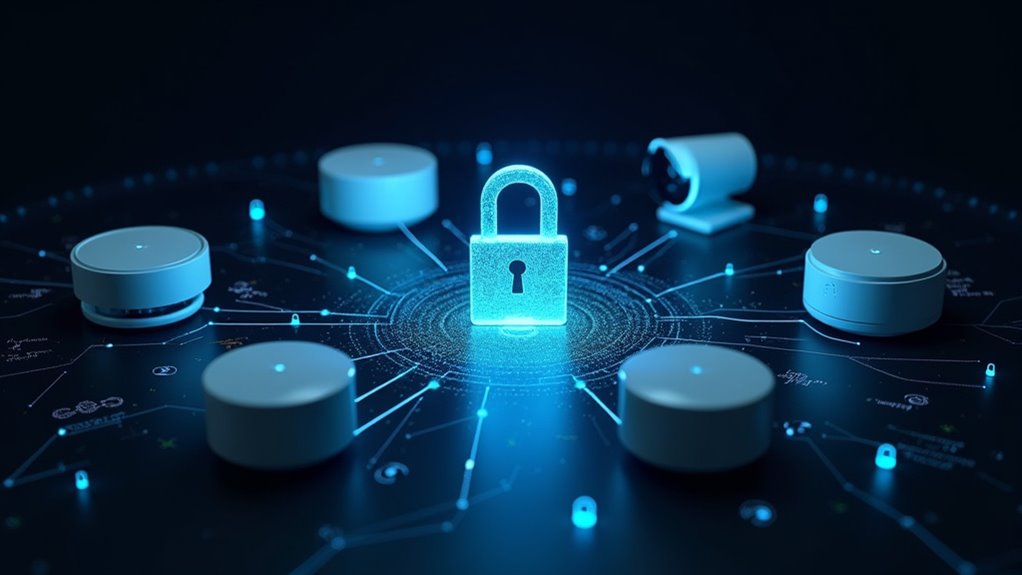

IoT encryption techniques combine symmetric and asymmetric methods to protect device communications. Symmetric encryption like AES provides fast, efficient security for data transfers, while asymmetric approaches like RSA and ECC establish secure connections between devices. Modern protocols such as MQTT with TLS and CoAP offer lightweight security options for constrained networks. Manufacturers increasingly implement hybrid solutions that balance processing capabilities with robust protection. The expanding IoT landscape demands even more sophisticated encryption strategies.

As the Internet of Things (IoT) continues to weave itself into the fabric of modern life, encryption has become the vital armor protecting billions of connected devices from increasingly sophisticated cyber threats. The diverse landscape of encryption technologies offers various approaches to securing IoT communications, each with its own strengths and ideal use cases.
At the foundation of IoT security lies symmetric encryption, particularly the AES algorithm, which provides rapid encryption and decryption using a single key. While AES remains the gold standard for many IoT applications due to its efficiency, newer lightweight alternatives like PRESENT and CLEFIA have emerged to address the unique constraints of resource-limited devices. These algorithms deliver essential security while minimizing power consumption and computational overhead. Furthermore, industrial control systems often rely on robust encryption to protect critical infrastructure from cyber threats. The use of cryptography algorithms ensures that data is encrypted in a manner that is both secure and efficient for the specific application. Additionally, the rise of IoT botnets highlights the urgency of implementing effective security measures to prevent widespread attacks. The integration of AI and ML in cyber security enhances threat detection and response, providing an additional layer of security to these encryption methods.
Asymmetric encryption plays a significant role in establishing secure connections between IoT devices and their control systems. RSA and ECC stand out as primary choices, with ECC gaining popularity due to its smaller key sizes and stronger security guarantees. However, the looming threat of quantum computing has pushed the industry toward developing post-quantum encryption methods, including promising approaches like lattice-based cryptography and multivariate systems.

The real-world implementation of these encryption techniques often relies on specialized IoT communication protocols. MQTT, secured with TLS, has become the de facto standard for many IoT deployments, while CoAP provides a lightweight alternative for constrained networks. These protocols work in conjunction with various encryption methods to guarantee data confidentiality and integrity across the entire communication chain.
A hybrid approach, combining the speed of symmetric encryption with the key management benefits of asymmetric systems, has proven particularly effective in IoT environments. This strategy allows devices to establish secure connections using asymmetric encryption for initial key exchange, then switch to faster symmetric encryption for ongoing communication. The approach provides an ideal balance between security and performance.
Looking ahead, the evolution of encryption in IoT faces several challenges. The need to protect against both current and future threats while maintaining efficiency has led to increased interest in adaptive security solutions. These systems can adjust their encryption strength based on the sensitivity of the data being transmitted and the available resources of the device.
The implementation of encryption in IoT devices requires careful consideration of power consumption, processing capabilities, and network bandwidth. Manufacturers must balance these factors while guaranteeing their devices remain secure against evolving threats. In 2025, obtaining essential certifications in cybersecurity can further enhance professionals’ understanding of the encryption methods applicable to IoT environments.

As IoT continues to expand, the development of more efficient and secure encryption methods remains vital for protecting the vast network of connected devices that increasingly control our daily lives.
Frequently Asked Questions
How Does Encryption Impact Battery Life in Iot Devices?
Encryption considerably impacts IoT device battery life through increased power consumption.
When devices encrypt data, they require additional processing power and memory resources, leading to faster battery drain. The impact varies based on encryption strength – for example, AES-256 uses about 16% more energy than AES-128.
Factors like data transmission overhead and network constraints also contribute to battery depletion.

Hardware acceleration and lightweight protocols can help mitigate these effects.
What Are the Legal Requirements for Iot Encryption in Different Countries?
Legal requirements for IoT encryption vary considerably by region.
China enforces strict controls, requiring government certification of cryptography products and imposing penalties for non-compliance.
India mandates security measures under the IT Act, with potential jail time for violations.

Canada focuses on data privacy through PIPEDA, while Cape Verde has minimal regulation but requires providers to enable legal interception.
Cameroon requires authorization for cryptographic services, though software-embedded functions are exempt.
Can Quantum Computing Break Current Iot Encryption Methods?
Yes, quantum computing poses a significant threat to current IoT encryption methods.
Traditional encryption algorithms like RSA and ECC could be broken by quantum computers in hours rather than the millions of years it would take classical computers. This vulnerability stems from quantum computers’ ability to use qubits to process multiple calculations simultaneously.

However, researchers are developing quantum-resistant cryptography solutions to protect IoT devices from these future threats.
How Often Should Encryption Keys Be Updated in Iot Networks?
IoT encryption key update frequency depends on several critical factors. High-risk systems handling sensitive data should rotate keys every few days to weeks, while less critical devices may update monthly or quarterly.
Best practices suggest implementing automated rotation policies on 30-day intervals, with flexibility for manual updates when needed. Organizations should consider data sensitivity, access patterns, and compliance requirements when determining ideal update schedules.
System monitoring should trigger additional rotations if security threats emerge.
What Backup Measures Exist if Encryption Fails During Critical Iot Operations?
Several backup measures protect IoT operations when encryption fails.
Failover encryption services automatically switch to secondary protocols, while multi-layered encryption guarantees redundant protection.
Hardware Security Modules manage key storage independently, providing continuous operation.
Air-gapped backups and immutable storage protect data integrity, while real-time monitoring systems detect failures quickly.
DRaaS solutions enable rapid recovery, and redundant processing nodes maintain operations during system changes.